






Molissa Smith - 09 Aug, 2026
0 commentsYour first home exchange might feel like a big step.
You're trusting someone with your home, staying in theirs and figuring out a process you've probably never experienced before.
But it doesn't have to be complicated.
The easiest way to approach your first exchange is to break it down into a series of simple steps. From creating your profile and finding the right home to having those first conversations, preparing your own home and eventually turning the key in the door, each stage has its own things to think about.
And you don't need to know everything before you start.
Here's where to begin.
1. Is Home Exchange Right for You?
Let's start with the question underneath almost every other question:
Can I really do this?
In principle, home exchange can work for all sorts of people and all sorts of homes. You don't need a second property, a huge house or a perfectly styled home.
You do need to be comfortable with the basic idea: someone will stay in your home while you're staying in theirs.
That's where trust comes in.
Home exchange works because two people who may never have met before are willing to open their homes to each other and treat each other's belongings with care.
For first-time exchangers, the questions are often practical.
Can I exchange if I rent my home?
Potentially, yes — but check the terms of your tenancy agreement first. If you're unsure whether home exchange is permitted, speak to your landlord or letting agent before making an arrangement.
What about insurance?
Don't assume your existing home insurance automatically covers every type of home exchange arrangement. Check your policy and speak to your insurer if you're unsure what is covered while someone else is staying in your home.
Some home exchange platforms also offer additional protection. On Habiqo, members can choose optional damage protection for additional peace of mind.
What if nobody wants my home?
This is one of those fears that can stop people before they've even started.
The reality is that your first enquiry might not turn into an exchange. Neither might your second.
That doesn't necessarily mean there's anything wrong with your home.
Dates have to work. Destinations have to work. Families have different needs. Someone might love your home but have no reason to visit your area right now.
The right exchange is about finding a match, not winning a popularity contest.
Your home might be exactly what someone is looking for. You just haven't found each other yet.
Do I need to host before I can travel?
Not necessarily.
There isn't one correct order to home exchange. You can host first, travel first or arrange an exchange that suits your circumstances.
And that brings us to one of the most important things to understand about how home exchange actually works.

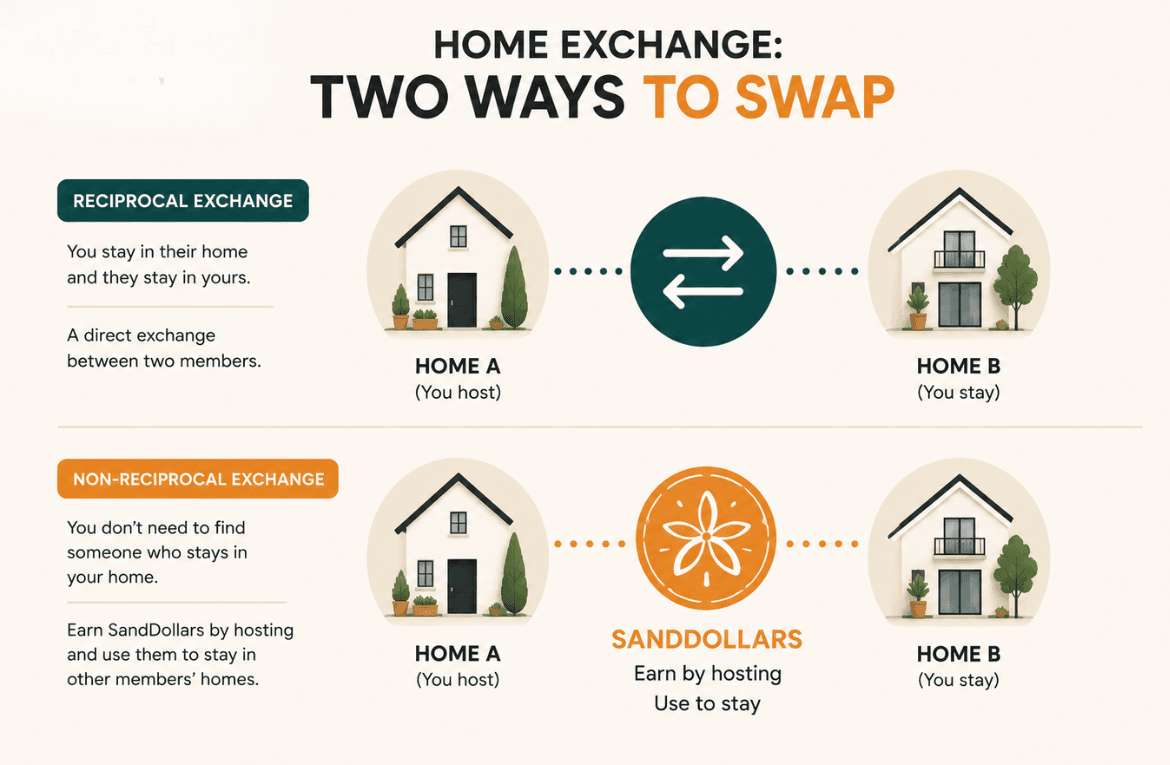
2. Reciprocal vs Non-Reciprocal Home Exchange: How Does It Work?
Before you start searching, it helps to understand that home exchange doesn't always mean two people swapping homes at exactly the same time.
What is a reciprocal home exchange?
A reciprocal exchange is the traditional model.
You stay in another member's home and they stay in yours, either at the same time or at different times.
For example, you might stay in someone's home in Barcelona while they stay in yours in London.
The two members are exchanging directly with each other.
What is a non-reciprocal home exchange?
A non-reciprocal exchange gives you more flexibility.
You don't necessarily have to find someone who wants to stay in your home in return.
Instead, you can host one member and use the exchange credit you've earned towards a stay in another member's home.
On Habiqo, these credits are called SandDollars.
What are SandDollars?
SandDollars are Habiqo's internal exchange credits. They aren't money and can't be bought.
Members can earn SandDollars through activities such as hosting and then use them towards stays in other members' homes.
This means you don't necessarily have to find someone who wants to stay in your home at exactly the same time — or even someone who wants to visit your area at all — for home exchange to work.
That's one of the reasons non-reciprocal exchanges can open up so many more possibilities.
You might host someone visiting your area, earn SandDollars and later use them to stay in a home somewhere you've always wanted to visit.
You don't need to understand every type of exchange before you begin.
The important thing is knowing that you're not limited to finding one person whose travel plans happen to match yours perfectly.
3. Create a Profile People Can Trust
Here's something first-time exchangers sometimes overlook:
People aren't only choosing your home. They're choosing whether your home is right for them.
Your location, number of bedrooms and facilities all matter. But so do the details that help another member understand what staying in your home will actually be like.
If you're travelling as a family, say so. If you have pets, mention them. If there's something particular about your home that guests should know, be upfront about it.
Use clear, recent photos and complete the important parts of your profile.
You don't need to write your life story or create a perfect-looking profile.
You simply want another member to be able to look at your listing and think:
“I can see this working for us.”
And that's also where verification matters.
When you're meeting someone through a home exchange platform, you want to know that there are genuine details behind the profile.
On Habiqo, members are asked to submit information for verification, including their identity, phone number, address and email. This gives both sides another layer of confidence before they start arranging an exchange.

4. How to Find Your First Home Exchange
Now comes the fun part.
Start searching for the destination you'd like to visit and see what's available. Browse homes, explore different locations, use the filters to narrow down your options and use the map to get a feel for where the homes are located.
You might start with one destination in mind and discover somewhere completely different that you hadn't considered.
When you find a home that catches your eye, save it so you can easily come back to it later.
Understanding the Habiqo calendar
When you open a listing, you'll see different colours on the member's calendar showing what type of exchange they're open to:
- Green: Open to any request
- Orange: Looking for a traditional swap
- Purple: Available for a SandDollar swap
- Blue: Hospitality swap
- Grey: Occupied
You don't need to understand every option before you start browsing. Use the calendar as a guide rather than assuming it tells you everything.
For example, you might find a home you absolutely love, but the dates or exchange type you're looking for don't appear to line up perfectly.
Don't automatically rule it out.
A member may have some flexibility or be open to a different type of exchange.
If the home looks like a great fit, send the member a message and ask.
And if you're using the map, there's another important reassurance: your exact home address is never displayed publicly. The map shows an approximate location, giving other members an idea of where your home is without revealing its precise location.
The whole point of this stage is to explore.
Save the homes that catch your eye, discover destinations you hadn't considered and don't be afraid to reach out when something feels like a good match.

5. What Should You Say in Your First Home Exchange Message?
This is probably the point where first-time exchangers hesitate most.
You've found a home you love, you've looked at the listing and the calendar, and now you have to actually send the message.
What do you say?
Keep it simple.
Introduce yourself briefly, explain what caught your attention about their home, say who you're travelling with and give them the dates you're interested in.
For example:
Hi Sarah, I came across your home while looking for somewhere to stay in Lisbon. We're travelling as a family of four to attend a family wedding and your location is perfect. We'd love to explore whether our homes and dates could work for an exchange.
You don't need to write a long message.
Give the other member enough context to understand who you are, why you're interested and what you're hoping might work.
If you're interested in a home but the calendar doesn't show exactly what you're looking for, it's still worth asking.
And don't worry if your first message doesn't result in an exchange.
People have different plans, dates and circumstances. Your first few enquiries may not work out.
A “no” doesn't necessarily mean your home isn't suitable. It may simply not be the right match this time.
Start the conversation through the Habiqo messaging system so there's a clear record of your initial contact.
If you're both interested, take the conversation further. Arrange a video call if you'd like to put a face to the name, or continue chatting through WhatsApp, Zoom or whatever works comfortably for both of you.
The important thing isn't to rush into an agreement.
It's to get to know each other, ask questions and work out whether the exchange feels right for both sides.
6. Should You Talk Before Agreeing to an Exchange?
Once you've started talking and there seems to be a potential match, take the time to get to know the person behind the home.
For many experienced exchangers, a quick video call is a useful way to build that initial connection. There are also a few simple habits experienced exchangers tend to stick to before they ever arrive.
The habits experienced exchangers tend to stick to
You don't need to turn it into an interview.
Talk about the things that matter to both of you:
- Who will be travelling?
- What time are you expecting to arrive and leave?
- Are there children or pets involved?
- Are there particular house rules or things to be aware of?
- What are you expecting from the exchange?
- Is there anything either of you is unsure about?
This is also the time to discuss the practical details that can easily become assumptions if they're not talked about beforehand — cleaning, keys, parking, pets, plants, use of particular rooms or anything else that's important to either household.
If something matters to you, talk about it before you agree to the exchange.
A video call isn't about proving that someone is trustworthy. It's about giving both sides the opportunity to feel comfortable with the person they're about to share homes with.
And sometimes, after a conversation, you realise that the exchange isn't quite the right fit.
That's okay.
Finding the right match is more important than simply finding an exchange.

7. Agree the Exchange — Then Finalise It
Once you've had those conversations and both sides are happy to move forward, slow down and make sure you're both clear on what you've agreed.
Confirm the:
- Dates
- Number of guests
- Arrival and departure arrangements
- Cleaning expectations
- Pets
- Keys
- Parking, if relevant
- Anything specific about the home or your stay
Don't rely on assumptions.
If there's something important to you, discuss it before you finalise the exchange.
Once you've agreed everything, come back to Habiqo and finalise the exchange on the platform.
Keeping the exchange on the platform gives both members a clear record of what has been agreed. It also means your confirmed exchange is properly recorded, and you can use the countdown and reminders leading up to your trip.
You may have had conversations through the platform, over WhatsApp or during a video call, but the final agreement should be recorded on Habiqo.
That way, both sides know exactly what they're agreeing to.
8. How to Prepare Your Home for a Home Exchange
One of the biggest questions first-time home exchangers ask is surprisingly simple:
What am I actually supposed to do with my home?
Do you remove your family photographs? Empty your cupboards? Clear every drawer?
The short answer is: you don't need to turn your home into an Airbnb.
Home exchange is about living in someone else's home, and that means homes are allowed to look like homes. Your photographs, personal touches and everyday belongings don't need to disappear just because someone else is staying there.
The expectation is simple:
Clean, comfortable and ready for someone else to live in.
Make sure the kitchen and bathrooms are properly clean, beds are ready and the areas your guests will use are in a condition you'd be happy to arrive to yourself.
You don't need to make your home look untouched.
What can make a big difference, however, is creating a little space for your guests.
Leave some room in a wardrobe or chest of drawers, put out a few empty hangers and, particularly if they're staying for more than a couple of nights, make sure there's space in the fridge and freezer for their food.
If there are valuable, fragile or particularly personal items that you're not comfortable leaving behind, put them somewhere safe before you leave.
And remember that finding the right match matters.
Someone travelling with children may naturally be more comfortable staying in a family home. A pet lover may be a better fit for a home with animals.
Your home doesn't have to suit everyone.
If you're unsure about something, talk about it before the exchange.

Create a simple home manual
Once your guests arrive, one of the simplest ways to help them settle in is to put all the useful information in one place.
Your home manual might include:
- Wi-Fi details
- How to use appliances
- Heating or air-conditioning instructions
- Rubbish and recycling information
- Parking arrangements
- Local emergency contacts
- Information about pets, plants or anything that needs looking after
- Anything particular about your home that a guest wouldn't know instinctively
Think of it as giving your guests a gentle head start.
They've arrived, they've put their bags down and they're probably ready to make a cup of coffee. Having the essentials in one place means they can settle in without having to message you about every little thing.
Peta, an experienced home exchanger with more than 150 exchanges, has also created a comprehensive home exchange manual that you can explore here for inspiration when creating your own.
The aim isn't to create a manual the size of a novel.
It's simply to give your guests the information they'd otherwise have to ask you for.

9. How Does Arrival and Key Handover Work?
After all the planning, there is one thing you really don't want to leave until the last minute:
Getting into the home.
Make sure you know exactly how the key handover is going to work.
Will your host be there to greet you? Will a neighbour have the keys? Is there a lockbox? Are the keys being left somewhere else? And what happens if your flight is delayed?
If you're hosting, make those instructions as clear as possible.
If you're travelling, don't be afraid to ask questions until you know exactly what to expect.
The last thing you want is for your guests to arrive after a long journey and discover that nobody is quite sure where the keys are.
Equally, if you're the one arriving, you don't want to be standing outside someone else's home wondering how you're supposed to get in.
This is also where your home manual can help. Once you're inside, you should be able to find the essentials without having to message your host for every little thing.
And remember that Habiqo only shares the exact address of the home with the other member closer to the relevant arrival or departure date, rather than displaying it publicly on the map.
Your approximate location can be seen when browsing, but your precise address remains private until it's needed for the exchange.
A smooth arrival is simple:
Both sides should know what is happening before anyone reaches the front door.

10. What Happens During a Home Exchange?
Once you've arrived and settled in, the exchange itself should feel much less complicated than all the planning that came before it.
You don't need to be in constant contact with your host or guest.
But if you're unsure how something works, ask.
If something isn't clear, don't guess.
And if something goes wrong, let the other person know rather than hoping it will sort itself out.
The same applies if you accidentally damage something. Things can happen when people are living in an unfamiliar home. Being honest and communicating quickly gives both sides the chance to deal with the situation calmly.
If you've been given the details of a local contact or neighbour, keep them somewhere easy to find. And if you're hosting, make sure your guests know how to reach you if they need help.
You don't have to be available every minute of the day.
You're both there to enjoy your time away.
It's simply about knowing that if something comes up, there's a clear way to deal with it.
11. What Should You Do When the Exchange Ends?
When the exchange comes to an end, there are a few simple things worth taking care of before you close the door for the last time.
If you've agreed to clean the home before you leave, make sure that's done. Return the keys as discussed, and let your host know you've left if that's part of your arrangement.
And don't underestimate a simple thank you.
A handwritten note, a small gift or a local treat isn't expected, but it's a lovely way to acknowledge the person who opened their home to you.
At Habiqo, our philosophy is simple:
Leave the home as you met it — or even better.
That doesn't mean trying to recreate the home exactly as you found it. It means treating someone else's home with the same care and respect you'd want them to show yours.
Don't forget to leave your review on the platform, too.
Reviews help future members understand what it's like to exchange with someone and build confidence within the community. Even if you've exchanged with the same person before, each exchange is a new experience and deserves its own review.
And a successful home exchange doesn't necessarily end when you hand the keys back.
Sometimes you find a place you want to return to. Sometimes you meet people you'd happily exchange with again. And sometimes a one-off holiday turns into an ongoing connection.
That's one of the things that makes home exchange so rewarding.

Ready for Your First Home Exchange?
Your first home exchange doesn't have to be perfect.
You don't need years of experience, a second home or a house that looks like it belongs in a magazine.
You need an open mind, clear communication and a willingness to trust someone with your home while you experience theirs.
The rest comes with experience.
You might not know exactly where you want to go yet. You might not have your dates worked out. You might even be wondering whether anyone would want to stay in your home.
That's okay.
Start by exploring.
Create your profile, look at the homes available, get a feel for how exchanges work and see where the idea takes you.
You might not know where your first exchange will take you yet.
But the first step is simple:
Start looking.
Explore Habiqo Home Swap and start searching for your first exchange.
Share your story
Tell us your story and get published on our blog. Send us your story
Send us your story